
Differences Between Cloud Security and On-Premise Security
Sven Gusek / 17.05.2024
Table Content
Critical differences between Cloud Security and On-Premise Security
Environment and Control
Scalability and Flexibility
Cost Structure
Compliance and Regulatory Considerations
Threat Management and Response
Disaster Recovery and Business Continuity
Find the best fit for your business
Hybrid Approach
Conclusion
Explore differences between Cloud Security & On-Premise Security. Find the best fit for your business based on control, cost, scalability, & compliance.
In today’s digital landscape, businesses must choose between cloud security and on-premise security. These are two distinct approaches to safeguarding information and systems, each with unique characteristics and challenges.
The critical differences between Cloud Security and On-Premise Security primarily revolve around the distinct environments, control models, scalability, cost structures, and compliance considerations associated with each. Here's a breakdown of these differences:
Critical differences between Cloud Security and On-Premise Security
Environment and Control
Cloud Security:
- Shared Responsibility Model: Security responsibilities are divided between the cloud service provider (CSP) and the customer. CSPs handle the security of the cloud infrastructure, including patching, vulnerability management, and baseline security measures, while customers are responsible for securing their data and applications within the cloud.
- Remote Management: Security measures are managed remotely, often with automated tools provided by the CSP.
- Abstracted Infrastructure: Users have limited control over the underlying hardware and must rely on the CSP for infrastructure security.
On-Premise Security:
- Full Control: Organizations have complete control over implementing and maintaining their security measures, from physical hardware to software configurations. This includes patching vulnerabilities, detecting threats, and responding to incidents. This requires a skilled IT security team.
- Localized Management: Security is managed on-site, allowing for direct oversight and customization.
- Tangible Infrastructure: Physical access to hardware allows for direct intervention and customization of security protocols.
Scalability and Flexibility
Cloud Security:
- Elasticity: Provides greater scalability, allowing you to easily scale storage and resources on demand. This is cost-effective for fluctuating needs, but you can have some control over specific security configurations.
- Global Reach: Security measures can be deployed globally with minimal latency, benefiting geographically distributed operations.
On-Premise Security:
- Fixed Capacity: Scalability is limited by the physical infrastructure, requiring significant investment to expand. Scaling up infrastructure can be expensive and time-consuming.
- Localized Reach: Primarily suited for localized operations, with additional complexity for securing remote locations.
Cost Structure
Cloud Security:
- OPEX Model: Costs are typically Operational Expenses, with pay-as-you-go models allowing for predictable budgeting. However, cloud service subscriptions can add up over time.
- Lower Initial Investment: Lower upfront costs as infrastructure is rented, not purchased.
On-Premise Security:
- CAPEX Model: Costs are primarily Capital Expenses, with significant initial investment required for hardware and software to manage the infrastructure.
- Maintenance Costs: Ongoing costs for maintenance, upgrades, and staffing.
Compliance and Regulatory Considerations
Cloud Security:
- Shared Compliance: CSPs often provide compliance certifications and help customers meet regulatory requirements, though customers must ensure their own compliance for data and applications.
- Third-Party Audits: Rely on CSPs for third-party audit certifications and compliance documentation.
On-Premise Security:
- Direct Compliance Responsibility: Organizations must directly manage and demonstrate compliance with all relevant regulations.
- Tailored Compliance: Easier to implement highly customized security measures to meet specific regulatory needs.
Threat Management and Response
Cloud Security:
- Advanced Threat Detection: CSPs often provide advanced threat detection and mitigation tools, leveraging large-scale data analysis and AI.
- Rapid Updates: Security patches and updates are often automatically managed by the CSP, ensuring timely protection against emerging threats.
On-Premise Security:
- Custom Threat Management: Organizations can deploy highly customized threat detection and response systems tailored to their specific environment.
- Manual Updates: Requires dedicated IT staff to manage security updates and patches, which can be slower than automated systems.
Disaster Recovery and Business Continuity
Cloud Security:
- Built-In Resilience: Cloud providers often offer built-in disaster recovery and business continuity solutions with geographically redundant data centres.
- Rapid Recovery: Ability to quickly spin up resources in different locations in the event of a disaster.
On-Premise Security:
- Customized Solutions: Organizations must design and implement their own disaster recovery and business continuity plans.
- Physical Dependency: Recovery may be slower and more complex due to dependency on physical infrastructure.
Find the best fit for your business
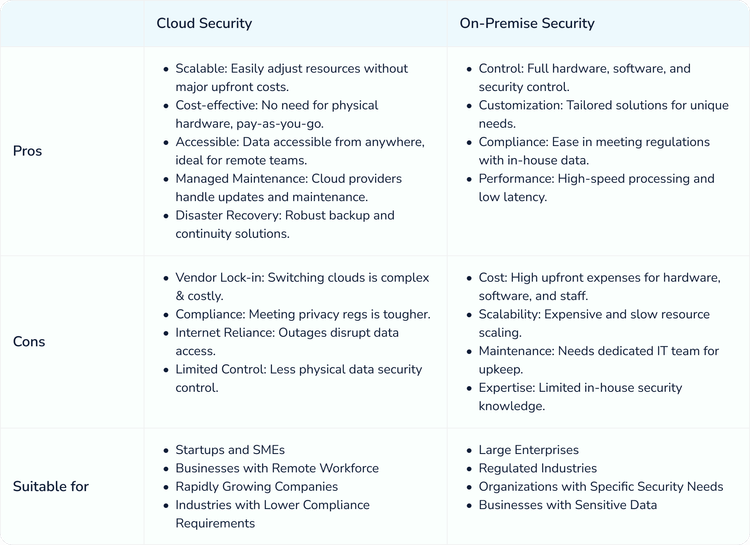
Hybrid Approach
Many businesses adopt a hybrid approach, combining both cloud and on-premise solutions to leverage the benefits of both. This can be particularly effective for:
Balancing Costs and Control: Using the cloud for general operations while keeping sensitive data on-premise.Gradual Transition: Allowing a step-by-step migration to the cloud while maintaining some critical systems in-house.Optimized Performance: Keeping latency-sensitive applications on-premise while using the cloud for scalable, less time-critical tasks.
Conclusion
The choice between cloud security and on-premise security depends on factors such as the level of control desired, scalability needs, budget constraints, regulatory requirements, and organizational resources. Cloud security offers flexibility, cost efficiency, and advanced tools, while on-premise security provides maximum control and customization.
Each approach has its advantages and challenges, and often, a hybrid approach that combines both may be the most effective strategy for many organizations. Consider your budget, IT expertise, and compliance requirements when making your decision.
Popular Posts

Sven Gusek / 19.08.2025
Cybersicherheit Enthüllt: Wenn Schutzschilde Zu Tödlichen Waffen Werden

Sven Gusek / 21.07.2025
Unter dem Radar: Chinas “Massistant”-Tower plündert Ihre Geheimnisse in Sekunden
Sven Gusek / 10.07.2025
Jenseits von Passwörtern: 5 Identitätsbasierte Angriffe, die den Einzelhandel erschüttern

Sven Gusek / 01.07.2025
Chinese VPNs on Apple and Google Stores: The Privacy Trap You Didn’t See Coming
Sven Gusek / 19.06.2025
Secure-90: Revolutionäre Cybersicherheit in nur 90 Tagen
Sven Gusek / 20.05.2025
Reisebuchungsbetrug stoppen: IT-Sicherheitsstrategien weltweit
Sven Gusek / 06.05.2025
90% der Sicherheitsverletzungen werden durch menschliches Versagen verursacht

Sven Gusek / 24.04.2025
Why Browser-Based Security is the Future of Phishing Defense

Sven Gusek / 21.04.2025
Credential-Based Cyberattack Recovery in 7 Steps

Sven Gusek / 16.04.2025
Crypto Job Scams Unmasked: Essential Tips For Avoiding

Sven Gusek / 31.03.2025
Critical Alert: Mitigating Splunk’s RCE Vulnerability
Sven Gusek / 20.03.2025
CISA Warns: Unpacking the Fortinet FortiOS Authentication Vulnerability
Sven Gusek / 13.03.2025
Fortinet Security Alert: Critical Vulnerabilities Demand Immediate Patching

Sven Gusek / 24.02.2025
Something is Watching... But You Cannot See It

Sven Gusek / 10.02.2025
SOC & SIEM: The Perfect 24/7 Love Story

Sven Gusek / 06.02.2025
Love in the Digital Age: When Hearts Need Encryption

Sven Gusek / 08.01.2025
Cybersecurity Puzzles: Can You Solve These Real-World Data Breach Scenarios?

Sven Gusek / 30.09.2024
Why Many People Still Undervalue Cybersecurity Despite Breaches

Sven Gusek / 23.09.2024
Security Is a Comprehensive Strategy, Not Just a Checkbox

Sven Gusek / 17.09.2024
Fortinet Claims Data Breach: Key Details and Lessons Learned

Sven Gusek / 06.09.2024
Password Reset Attack: Preventing Account Takeovers (ATO)

Sven Gusek / 04.09.2024
Phishing in the Age of Deepfakes: How Attackers Are Evolving

Sven Gusek / 27.08.2024
Lessons from Palo Alto Networks Cloud Misconfigurations

Sven Gusek / 19.08.2024
Post-Exploitation Tactics in Ivanti and Fortigate VPN Compromises

Sven Gusek / 07.08.2024
Digital Identity and Authentication: The Future of Secure Access

Sven Gusek / 02.08.2024
Secure Workflow Automation Guide for Security Teams

Sven Gusek / 31.07.2024
Dark Web Intelligence: Predicting and Preventing Threats

Sven Gusek / 26.07.2024
Routers vs. Switches: Key Differences and Network Security Roles

Sven Gusek / 22.07.2024
Global IT Outage: Lessons from the CrowdStrike Update Crisis

Sven Gusek / 16.07.2024
Password Leak RockYou2024: The Largest Passwords Breached

Sven Gusek / 12.07.2024
The Importance of Security Audits and Penetration Testing in Application Development

Sven Gusek / 10.07.2024
Lessons from APT40 China-linked Hacking Group's Breach

Sven Gusek / 05.07.2024
Lessons from TeamViewer's Recent Russian APT Hack

Sven Gusek / 03.07.2024
Cybersecurity Workforce Shortage: Effective Solutions

Sven Gusek / 28.06.2024
Ethical Hacking: Role and Importance in Modern Security

Sven Gusek / 20.06.2024
Data Privacy and Protection: Techniques for Safeguarding Sensitive Information

Sven Gusek / 31.05.2024
Exploring Ransomware Trends and Defense Strategies

Sven Gusek / 24.05.2024
How Generative AI is Shaping the Future of Cybersecurity

Sven Gusek / 17.05.2024
Differences Between Cloud Security and On-Premise Security

Sven Gusek / 09.05.2024
Insider Threats vs. External Threats: A Drill Down

Sven Gusek / 03.05.2024
Endpoint Security Tips: Fortify Your Network's Defenses

Sven Gusek / 04.04.2024
The Stealthy Evolution of Malware: Insights from the Linux’s CVE XZ Utils Backdoor Incident

Judia Nguyen / 01.04.2024
Learning from Cisco's Latest Security Patches to Stay Ahead of Changing DDoS Threats
Judia Nguyen / 29.03.2024
Urgent Patch Needed for Vulnerable Microsoft Exchange Servers
Judia Nguyen / 27.03.2024
Patch Now! Critical Fortinet FortiClient EMS Vulnerability Exploited

Judia Nguyen / 25.03.2024
New Loop DoS Attack Threatens Hundreds of Thousands of Systems

Judia Nguyen / 22.03.2024
Beware Uploading Files Because Ransomware Can Lurk in Unexpected Places

Judia Nguyen / 21.03.2024
The Domino Effect: When a Cyberattack Topples Critical Infrastructure

Judia Nguyen / 20.03.2024
The Sneaky Evolution of DDoS Attacks: Are ISPs Our Only Hope?

Judia Nguyen / 18.03.2024
Analysing the Dynamic Cybersecurity Environment Insights from the Red Canary Report

Judia Nguyen / 14.03.2024
GhostRace - New Hardware Attack Demands Strong Endpoint Security

Judia Nguyen / 11.03.2024
Handling the Quantum Threat to Safeguard Our Digital Future

Judia Nguyen / 07.03.2024
Protecting Your Cloud Infrastructure by Eliminating Linux Malware Risks

Judia Nguyen / 28.02.2024
Navigating the Threat Landscape: Malware Campaigns Exploiting Google Cloud Run

Sven Gusek / 22.02.2024
Sicherheitslücke bei Microsoft: Midnight Blizzard erlangt E-Mail-Zugang

Florian Reinholz / 22.02.2024
Der Einsatz von SOC as a Service kann der entscheidende Vorteil sein

Judia Nguyen / 21.02.2024
Prioritizing Essential Security Measures During Economic Recession: A Guide for Businesses

Judia Nguyen / 21.02.2024
Der Geist der Cybersicherheit in Vergangenheit, Gegenwart und Zukunft: gewonnene Erkenntnisse

Sven Gusek / 21.02.2024
The Future of IT Security in Germany: A Comprehensive Outlook

Sven Gusek / 21.02.2024
NIS-2 Regulation: A Turning Point for Network Security and Data Protection in the EU
New Posts
Sven Gusek / 19.08.2025
Cybersicherheit Enthüllt: Wenn Schutzschilde Zu Tödlichen Waffen Werden
Sven Gusek / 21.07.2025
Unter dem Radar: Chinas “Massistant”-Tower plündert Ihre Geheimnisse in Sekunden
Sven Gusek / 10.07.2025
Jenseits von Passwörtern: 5 Identitätsbasierte Angriffe, die den Einzelhandel erschüttern
Sven Gusek / 01.07.2025
Chinese VPNs on Apple and Google Stores: The Privacy Trap You Didn’t See Coming
Sven Gusek / 19.06.2025
Secure-90: Revolutionäre Cybersicherheit in nur 90 Tagen
Sven Gusek / 20.05.2025
Reisebuchungsbetrug stoppen: IT-Sicherheitsstrategien weltweit
Sven Gusek / 06.05.2025
90% der Sicherheitsverletzungen werden durch menschliches Versagen verursacht
Sven Gusek / 24.04.2025
Why Browser-Based Security is the Future of Phishing Defense
Sven Gusek / 21.04.2025
Credential-Based Cyberattack Recovery in 7 Steps
Sven Gusek / 16.04.2025
Crypto Job Scams Unmasked: Essential Tips For Avoiding

Sven Gusek / 04.04.2025
Mastering Privacy on Social Media Shared by Developer
Sven Gusek / 31.03.2025
Critical Alert: Mitigating Splunk’s RCE Vulnerability
Sven Gusek / 20.03.2025
CISA Warns: Unpacking the Fortinet FortiOS Authentication Vulnerability
Sven Gusek / 13.03.2025
Fortinet Security Alert: Critical Vulnerabilities Demand Immediate Patching
Sven Gusek / 24.02.2025
Something is Watching... But You Cannot See It
Sven Gusek / 10.02.2025
SOC & SIEM: The Perfect 24/7 Love Story
Sven Gusek / 06.02.2025
Love in the Digital Age: When Hearts Need Encryption
Sven Gusek / 08.01.2025
Cybersecurity Puzzles: Can You Solve These Real-World Data Breach Scenarios?
Sven Gusek / 30.09.2024
Why Many People Still Undervalue Cybersecurity Despite Breaches
Sven Gusek / 23.09.2024
Security Is a Comprehensive Strategy, Not Just a Checkbox
Sven Gusek / 17.09.2024
Fortinet Claims Data Breach: Key Details and Lessons Learned
Sven Gusek / 06.09.2024
Password Reset Attack: Preventing Account Takeovers (ATO)
Sven Gusek / 04.09.2024
Phishing in the Age of Deepfakes: How Attackers Are Evolving
Sven Gusek / 27.08.2024
Lessons from Palo Alto Networks Cloud Misconfigurations
Sven Gusek / 19.08.2024
Post-Exploitation Tactics in Ivanti and Fortigate VPN Compromises
Sven Gusek / 07.08.2024
Digital Identity and Authentication: The Future of Secure Access
Sven Gusek / 02.08.2024
Secure Workflow Automation Guide for Security Teams
Sven Gusek / 31.07.2024
Dark Web Intelligence: Predicting and Preventing Threats
Sven Gusek / 26.07.2024
Routers vs. Switches: Key Differences and Network Security Roles
Sven Gusek / 22.07.2024
Global IT Outage: Lessons from the CrowdStrike Update Crisis
Sven Gusek / 16.07.2024
Password Leak RockYou2024: The Largest Passwords Breached
Sven Gusek / 12.07.2024
The Importance of Security Audits and Penetration Testing in Application Development
Sven Gusek / 10.07.2024
Lessons from APT40 China-linked Hacking Group's Breach
Sven Gusek / 05.07.2024
Lessons from TeamViewer's Recent Russian APT Hack
Sven Gusek / 03.07.2024
Cybersecurity Workforce Shortage: Effective Solutions
Sven Gusek / 28.06.2024
Ethical Hacking: Role and Importance in Modern Security
Sven Gusek / 20.06.2024
Data Privacy and Protection: Techniques for Safeguarding Sensitive Information
Sven Gusek / 31.05.2024
Exploring Ransomware Trends and Defense Strategies
Sven Gusek / 24.05.2024
How Generative AI is Shaping the Future of Cybersecurity
Sven Gusek / 17.05.2024
Differences Between Cloud Security and On-Premise Security
Sven Gusek / 09.05.2024
Insider Threats vs. External Threats: A Drill Down
Sven Gusek / 03.05.2024
Endpoint Security Tips: Fortify Your Network's Defenses
Sven Gusek / 04.04.2024
The Stealthy Evolution of Malware: Insights from the Linux’s CVE XZ Utils Backdoor Incident
Judia Nguyen / 01.04.2024
Learning from Cisco's Latest Security Patches to Stay Ahead of Changing DDoS Threats
Judia Nguyen / 29.03.2024
Urgent Patch Needed for Vulnerable Microsoft Exchange Servers
Judia Nguyen / 27.03.2024
Patch Now! Critical Fortinet FortiClient EMS Vulnerability Exploited
Judia Nguyen / 25.03.2024
New Loop DoS Attack Threatens Hundreds of Thousands of Systems
Judia Nguyen / 22.03.2024
Beware Uploading Files Because Ransomware Can Lurk in Unexpected Places
Judia Nguyen / 21.03.2024
The Domino Effect: When a Cyberattack Topples Critical Infrastructure
Judia Nguyen / 20.03.2024
The Sneaky Evolution of DDoS Attacks: Are ISPs Our Only Hope?
Judia Nguyen / 18.03.2024
Analysing the Dynamic Cybersecurity Environment Insights from the Red Canary Report
Judia Nguyen / 14.03.2024
GhostRace - New Hardware Attack Demands Strong Endpoint Security

Judia Nguyen / 13.03.2024
Resolving the Limitations of XDR Modern Security and the Use of SASE
Judia Nguyen / 11.03.2024
Handling the Quantum Threat to Safeguard Our Digital Future
Judia Nguyen / 07.03.2024
Protecting Your Cloud Infrastructure by Eliminating Linux Malware Risks

Judia Nguyen / 04.03.2024
DDoS Hacktivism: A New Geopolitical Weapon
Judia Nguyen / 28.02.2024
Navigating the Threat Landscape: Malware Campaigns Exploiting Google Cloud Run

Judia Nguyen / 26.02.2024
Navigating the New Landscape of Cybersecurity Regulations and Consumer Rights

Sven Gusek / 22.02.2024
Cisco Unity Connection Vulnerability and Patch

Sven Gusek / 22.02.2024
The Evolution of Cybersecurity: A Look at Juniper's Latest Security Update

Sven Gusek / 22.02.2024
Fortinet Update: A Critical Step in Resolving Security Vulnerabilities 1
Sven Gusek / 22.02.2024
Sicherheitslücke bei Microsoft: Midnight Blizzard erlangt E-Mail-Zugang
Sven Gusek / 22.02.2024
Security Breach at Microsoft: Midnight Blizzard Gains Email Access

Sven Gusek / 22.02.2024
MITER's Innovative Initiative to Strengthen Cybersecurity in Critical Infrastructures
Florian Reinholz / 22.02.2024
Der Einsatz von SOC as a Service kann der entscheidende Vorteil sein

Florian Reinholz / 22.02.2024
Secure Access / ZTNA 2.0 | dynexo GmbH
Judia Nguyen / 21.02.2024
Prioritizing Essential Security Measures During Economic Recession: A Guide for Businesses

Judia Nguyen / 21.02.2024
2023: A Post-Mortem on Cyber Security - Bandaged Scars and Lingering Bruises
Judia Nguyen / 21.02.2024
Der Geist der Cybersicherheit in Vergangenheit, Gegenwart und Zukunft: gewonnene Erkenntnisse
Sven Gusek / 21.02.2024
The Future of IT Security in Germany: A Comprehensive Outlook
Sven Gusek / 21.02.2024
NIS-2 Regulation: A Turning Point for Network Security and Data Protection in the EU


