
Insider Threats vs. External Threats: A Drill Down
Sven Gusek / 09.05.2024
This blog post will delve into the critical distinction between insider and external threats, helping you understand the cybersecurity landscape.
Cybersecurity isn't just about building a fortress to keep hackers out. Not all threats come from the outside. Some of the most damaging attacks can originate from within the organization itself, by people who already have authorized access to your systems and data. These insider threats can be just as devastating as attacks from external threats like hackers and cybercriminals.
The Insider Threats: A Wolf in Sheep's Clothing
Insider threats pose a more insidious challenge. These threats come from individuals with authorized access to your systems and data, including employees, contractors, or even business partners. Unlike external threats, insiders already have a foot in the door, making their actions much harder to detect.
Imagine a disgruntled employee with access to customer data or a careless contractor who clicks on a suspicious link. Insider threats can be malicious, driven by revenge, competitors looking for strategic advantage, or individuals motivated by financial gain. But they can also be unintentional – a simple mistake can expose your entire network. For example, an employee falling victim to a phishing scam or downloading malware can unknowingly expose the entire organization.
The potential damage caused by insider threats can be significant. With their existing access, insiders can bypass security measures and:
- Steal sensitive data: Easily copy or transfer confidential information without raising suspicion.
- Sabotage systems: Cause significant disruption by deleting data or manipulating critical infrastructure.
- Sell access to external attackers: Open the door for external threats to exploit, leading to a larger-scale attack.
The biggest challenge with insider threats is their inherent trustworthiness. They already have legitimate access to systems and data, allowing them to bypass security measures designed to deter external attacks. Additionally, their knowledge of the organization's internal workings makes them particularly dangerous. They can target vulnerabilities with greater precision and fly under the radar by mimicking legitimate user activity.
The External Threats: The Classic Cybercriminals
External threats, on the other hand, are the more traditional cybersecurity foe. These threats come from attackers outside your organization. These are the more familiar cybercriminals we often think of – hackers, botnets, and state-sponsored actors. Their goals can range from stealing valuable data to disrupting operations (denial-of-service attacks) or conducting industrial espionage, including:
- Data theft: Stealing sensitive information such as financial records, customer data, or intellectual property.
- Disruption: Disabling or sabotaging critical systems to cause downtime and financial losses.
- Financial gain: Deploying ransomware or other extortion tactics to extract money from the organization.
Common tactics used by external threats include:
- Malware: Malicious software like viruses, worms, and ransomware that can infect devices, steal data, or disrupt operations.
- Phishing Attacks: Deceptive emails or messages designed to trick users into revealing sensitive information or clicking on malicious links.
- Hacking Attempts: Exploiting vulnerabilities in software, hardware, or network configurations to gain unauthorized access to systems and data.
- Social engineering: Exploiting human psychology to manipulate users into divulging sensitive information.
Spotting the Difference: Vigilance is Key
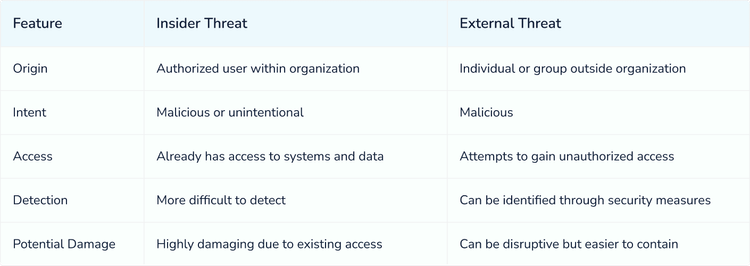
While both insider threats and external threats pose significant risks, they often leave different trails. External threats are typically easier to detect with security tools like firewalls that monitor network traffic for suspicious activity. However, insider threats can be much harder to identify due to their trusted access and ability to blend in. This is where user behaviour analytics (UBA) comes in. UBA monitors user activity for unusual patterns that might indicate an insider threat. Here's a quick breakdown of the key differences:
Building a Strong Defense: Security on Multiple Levels
Combating both insider threats and external threats requires a layered cybersecurity strategy that goes beyond just basic security software. Here are some key elements for a strong defense:
- Robust Security Controls: Implement firewalls, intrusion detection/prevention systems (IDS/IPS), data encryption, and access controls that limit access based on the principle of least privilege.
- Security Awareness Training: Regularly educate employees on security best practices, phishing scams, and how to identify and report suspicious activity. Foster a culture of cybersecurity awareness within your organization.
- User Activity Monitoring: Utilize UBA tools to detect anomalous user behaviour that might indicate an insider threat.
- Background Checks: Conduct thorough background checks on employees and contractors before granting access to critical systems and data.
- Incident Response Planning: Develop a well-defined incident response plan that outlines procedures for detecting, containing, eradicating, and recovering from security breaches, regardless of their source.
Conclusion
By understanding the unique characteristics of both insider and external threats, and implementing a proactive, multi-layered security approach, organizations can significantly reduce their cybersecurity risks and safeguard their valuable data and assets. Remember, cybersecurity is a team effort. With everyone in your organization playing their part, you can create a more secure digital environment for your business.
Popular Posts

Sven Gusek / 19.08.2025
Cybersicherheit Enthüllt: Wenn Schutzschilde Zu Tödlichen Waffen Werden

Sven Gusek / 21.07.2025
Unter dem Radar: Chinas “Massistant”-Tower plündert Ihre Geheimnisse in Sekunden
Sven Gusek / 10.07.2025
Jenseits von Passwörtern: 5 Identitätsbasierte Angriffe, die den Einzelhandel erschüttern

Sven Gusek / 01.07.2025
Chinese VPNs on Apple and Google Stores: The Privacy Trap You Didn’t See Coming

Sven Gusek / 19.06.2025
Secure-90: Revolutionäre Cybersicherheit in nur 90 Tagen
Sven Gusek / 20.05.2025
Reisebuchungsbetrug stoppen: IT-Sicherheitsstrategien weltweit
Sven Gusek / 06.05.2025
90% der Sicherheitsverletzungen werden durch menschliches Versagen verursacht

Sven Gusek / 24.04.2025
Why Browser-Based Security is the Future of Phishing Defense

Sven Gusek / 21.04.2025
Credential-Based Cyberattack Recovery in 7 Steps

Sven Gusek / 16.04.2025
Crypto Job Scams Unmasked: Essential Tips For Avoiding

Sven Gusek / 31.03.2025
Critical Alert: Mitigating Splunk’s RCE Vulnerability
Sven Gusek / 20.03.2025
CISA Warns: Unpacking the Fortinet FortiOS Authentication Vulnerability
Sven Gusek / 13.03.2025
Fortinet Security Alert: Critical Vulnerabilities Demand Immediate Patching

Sven Gusek / 24.02.2025
Something is Watching... But You Cannot See It

Sven Gusek / 10.02.2025
SOC & SIEM: The Perfect 24/7 Love Story

Sven Gusek / 06.02.2025
Love in the Digital Age: When Hearts Need Encryption

Sven Gusek / 08.01.2025
Cybersecurity Puzzles: Can You Solve These Real-World Data Breach Scenarios?

Sven Gusek / 30.09.2024
Why Many People Still Undervalue Cybersecurity Despite Breaches

Sven Gusek / 23.09.2024
Security Is a Comprehensive Strategy, Not Just a Checkbox

Sven Gusek / 17.09.2024
Fortinet Claims Data Breach: Key Details and Lessons Learned

Sven Gusek / 06.09.2024
Password Reset Attack: Preventing Account Takeovers (ATO)

Sven Gusek / 04.09.2024
Phishing in the Age of Deepfakes: How Attackers Are Evolving

Sven Gusek / 27.08.2024
Lessons from Palo Alto Networks Cloud Misconfigurations

Sven Gusek / 19.08.2024
Post-Exploitation Tactics in Ivanti and Fortigate VPN Compromises

Sven Gusek / 07.08.2024
Digital Identity and Authentication: The Future of Secure Access

Sven Gusek / 02.08.2024
Secure Workflow Automation Guide for Security Teams

Sven Gusek / 31.07.2024
Dark Web Intelligence: Predicting and Preventing Threats

Sven Gusek / 26.07.2024
Routers vs. Switches: Key Differences and Network Security Roles

Sven Gusek / 22.07.2024
Global IT Outage: Lessons from the CrowdStrike Update Crisis

Sven Gusek / 16.07.2024
Password Leak RockYou2024: The Largest Passwords Breached

Sven Gusek / 12.07.2024
The Importance of Security Audits and Penetration Testing in Application Development

Sven Gusek / 10.07.2024
Lessons from APT40 China-linked Hacking Group's Breach

Sven Gusek / 05.07.2024
Lessons from TeamViewer's Recent Russian APT Hack

Sven Gusek / 03.07.2024
Cybersecurity Workforce Shortage: Effective Solutions

Sven Gusek / 28.06.2024
Ethical Hacking: Role and Importance in Modern Security

Sven Gusek / 20.06.2024
Data Privacy and Protection: Techniques for Safeguarding Sensitive Information

Sven Gusek / 31.05.2024
Exploring Ransomware Trends and Defense Strategies

Sven Gusek / 24.05.2024
How Generative AI is Shaping the Future of Cybersecurity

Sven Gusek / 17.05.2024
Differences Between Cloud Security and On-Premise Security

Sven Gusek / 09.05.2024
Insider Threats vs. External Threats: A Drill Down

Sven Gusek / 03.05.2024
Endpoint Security Tips: Fortify Your Network's Defenses

Sven Gusek / 04.04.2024
The Stealthy Evolution of Malware: Insights from the Linux’s CVE XZ Utils Backdoor Incident

Judia Nguyen / 01.04.2024
Learning from Cisco's Latest Security Patches to Stay Ahead of Changing DDoS Threats

Judia Nguyen / 29.03.2024
Urgent Patch Needed for Vulnerable Microsoft Exchange Servers

Judia Nguyen / 27.03.2024
Patch Now! Critical Fortinet FortiClient EMS Vulnerability Exploited

Judia Nguyen / 25.03.2024
New Loop DoS Attack Threatens Hundreds of Thousands of Systems

Judia Nguyen / 22.03.2024
Beware Uploading Files Because Ransomware Can Lurk in Unexpected Places

Judia Nguyen / 21.03.2024
The Domino Effect: When a Cyberattack Topples Critical Infrastructure

Judia Nguyen / 20.03.2024
The Sneaky Evolution of DDoS Attacks: Are ISPs Our Only Hope?

Judia Nguyen / 18.03.2024
Analysing the Dynamic Cybersecurity Environment Insights from the Red Canary Report

Judia Nguyen / 14.03.2024
GhostRace - New Hardware Attack Demands Strong Endpoint Security

Judia Nguyen / 11.03.2024
Handling the Quantum Threat to Safeguard Our Digital Future

Judia Nguyen / 07.03.2024
Protecting Your Cloud Infrastructure by Eliminating Linux Malware Risks

Judia Nguyen / 28.02.2024
Navigating the Threat Landscape: Malware Campaigns Exploiting Google Cloud Run

Sven Gusek / 22.02.2024
Sicherheitslücke bei Microsoft: Midnight Blizzard erlangt E-Mail-Zugang

Florian Reinholz / 22.02.2024
Der Einsatz von SOC as a Service kann der entscheidende Vorteil sein

Judia Nguyen / 21.02.2024
Prioritizing Essential Security Measures During Economic Recession: A Guide for Businesses

Judia Nguyen / 21.02.2024
Der Geist der Cybersicherheit in Vergangenheit, Gegenwart und Zukunft: gewonnene Erkenntnisse

Sven Gusek / 21.02.2024
The Future of IT Security in Germany: A Comprehensive Outlook

Sven Gusek / 21.02.2024
NIS-2 Regulation: A Turning Point for Network Security and Data Protection in the EU
New Posts
Sven Gusek / 19.08.2025
Cybersicherheit Enthüllt: Wenn Schutzschilde Zu Tödlichen Waffen Werden
Sven Gusek / 21.07.2025
Unter dem Radar: Chinas “Massistant”-Tower plündert Ihre Geheimnisse in Sekunden
Sven Gusek / 10.07.2025
Jenseits von Passwörtern: 5 Identitätsbasierte Angriffe, die den Einzelhandel erschüttern
Sven Gusek / 01.07.2025
Chinese VPNs on Apple and Google Stores: The Privacy Trap You Didn’t See Coming
Sven Gusek / 19.06.2025
Secure-90: Revolutionäre Cybersicherheit in nur 90 Tagen
Sven Gusek / 20.05.2025
Reisebuchungsbetrug stoppen: IT-Sicherheitsstrategien weltweit
Sven Gusek / 06.05.2025
90% der Sicherheitsverletzungen werden durch menschliches Versagen verursacht
Sven Gusek / 24.04.2025
Why Browser-Based Security is the Future of Phishing Defense
Sven Gusek / 21.04.2025
Credential-Based Cyberattack Recovery in 7 Steps
Sven Gusek / 16.04.2025
Crypto Job Scams Unmasked: Essential Tips For Avoiding

Sven Gusek / 04.04.2025
Mastering Privacy on Social Media Shared by Developer
Sven Gusek / 31.03.2025
Critical Alert: Mitigating Splunk’s RCE Vulnerability
Sven Gusek / 20.03.2025
CISA Warns: Unpacking the Fortinet FortiOS Authentication Vulnerability
Sven Gusek / 13.03.2025
Fortinet Security Alert: Critical Vulnerabilities Demand Immediate Patching
Sven Gusek / 24.02.2025
Something is Watching... But You Cannot See It
Sven Gusek / 10.02.2025
SOC & SIEM: The Perfect 24/7 Love Story
Sven Gusek / 06.02.2025
Love in the Digital Age: When Hearts Need Encryption
Sven Gusek / 08.01.2025
Cybersecurity Puzzles: Can You Solve These Real-World Data Breach Scenarios?
Sven Gusek / 30.09.2024
Why Many People Still Undervalue Cybersecurity Despite Breaches
Sven Gusek / 23.09.2024
Security Is a Comprehensive Strategy, Not Just a Checkbox
Sven Gusek / 17.09.2024
Fortinet Claims Data Breach: Key Details and Lessons Learned
Sven Gusek / 06.09.2024
Password Reset Attack: Preventing Account Takeovers (ATO)
Sven Gusek / 04.09.2024
Phishing in the Age of Deepfakes: How Attackers Are Evolving
Sven Gusek / 27.08.2024
Lessons from Palo Alto Networks Cloud Misconfigurations
Sven Gusek / 19.08.2024
Post-Exploitation Tactics in Ivanti and Fortigate VPN Compromises
Sven Gusek / 07.08.2024
Digital Identity and Authentication: The Future of Secure Access
Sven Gusek / 02.08.2024
Secure Workflow Automation Guide for Security Teams
Sven Gusek / 31.07.2024
Dark Web Intelligence: Predicting and Preventing Threats
Sven Gusek / 26.07.2024
Routers vs. Switches: Key Differences and Network Security Roles
Sven Gusek / 22.07.2024
Global IT Outage: Lessons from the CrowdStrike Update Crisis
Sven Gusek / 16.07.2024
Password Leak RockYou2024: The Largest Passwords Breached
Sven Gusek / 12.07.2024
The Importance of Security Audits and Penetration Testing in Application Development
Sven Gusek / 10.07.2024
Lessons from APT40 China-linked Hacking Group's Breach
Sven Gusek / 05.07.2024
Lessons from TeamViewer's Recent Russian APT Hack
Sven Gusek / 03.07.2024
Cybersecurity Workforce Shortage: Effective Solutions
Sven Gusek / 28.06.2024
Ethical Hacking: Role and Importance in Modern Security
Sven Gusek / 20.06.2024
Data Privacy and Protection: Techniques for Safeguarding Sensitive Information
Sven Gusek / 31.05.2024
Exploring Ransomware Trends and Defense Strategies
Sven Gusek / 24.05.2024
How Generative AI is Shaping the Future of Cybersecurity
Sven Gusek / 17.05.2024
Differences Between Cloud Security and On-Premise Security
Sven Gusek / 09.05.2024
Insider Threats vs. External Threats: A Drill Down
Sven Gusek / 03.05.2024
Endpoint Security Tips: Fortify Your Network's Defenses
Sven Gusek / 04.04.2024
The Stealthy Evolution of Malware: Insights from the Linux’s CVE XZ Utils Backdoor Incident
Judia Nguyen / 01.04.2024
Learning from Cisco's Latest Security Patches to Stay Ahead of Changing DDoS Threats
Judia Nguyen / 29.03.2024
Urgent Patch Needed for Vulnerable Microsoft Exchange Servers
Judia Nguyen / 27.03.2024
Patch Now! Critical Fortinet FortiClient EMS Vulnerability Exploited
Judia Nguyen / 25.03.2024
New Loop DoS Attack Threatens Hundreds of Thousands of Systems
Judia Nguyen / 22.03.2024
Beware Uploading Files Because Ransomware Can Lurk in Unexpected Places
Judia Nguyen / 21.03.2024
The Domino Effect: When a Cyberattack Topples Critical Infrastructure
Judia Nguyen / 20.03.2024
The Sneaky Evolution of DDoS Attacks: Are ISPs Our Only Hope?
Judia Nguyen / 18.03.2024
Analysing the Dynamic Cybersecurity Environment Insights from the Red Canary Report
Judia Nguyen / 14.03.2024
GhostRace - New Hardware Attack Demands Strong Endpoint Security

Judia Nguyen / 13.03.2024
Resolving the Limitations of XDR Modern Security and the Use of SASE
Judia Nguyen / 11.03.2024
Handling the Quantum Threat to Safeguard Our Digital Future
Judia Nguyen / 07.03.2024
Protecting Your Cloud Infrastructure by Eliminating Linux Malware Risks

Judia Nguyen / 04.03.2024
DDoS Hacktivism: A New Geopolitical Weapon
Judia Nguyen / 28.02.2024
Navigating the Threat Landscape: Malware Campaigns Exploiting Google Cloud Run

Judia Nguyen / 26.02.2024
Navigating the New Landscape of Cybersecurity Regulations and Consumer Rights

Sven Gusek / 22.02.2024
Cisco Unity Connection Vulnerability and Patch

Sven Gusek / 22.02.2024
The Evolution of Cybersecurity: A Look at Juniper's Latest Security Update

Sven Gusek / 22.02.2024
Fortinet Update: A Critical Step in Resolving Security Vulnerabilities 1
Sven Gusek / 22.02.2024
Sicherheitslücke bei Microsoft: Midnight Blizzard erlangt E-Mail-Zugang
Sven Gusek / 22.02.2024
Security Breach at Microsoft: Midnight Blizzard Gains Email Access

Sven Gusek / 22.02.2024
MITER's Innovative Initiative to Strengthen Cybersecurity in Critical Infrastructures
Florian Reinholz / 22.02.2024
Der Einsatz von SOC as a Service kann der entscheidende Vorteil sein

Florian Reinholz / 22.02.2024
Secure Access / ZTNA 2.0 | dynexo GmbH
Judia Nguyen / 21.02.2024
Prioritizing Essential Security Measures During Economic Recession: A Guide for Businesses

Judia Nguyen / 21.02.2024
2023: A Post-Mortem on Cyber Security - Bandaged Scars and Lingering Bruises
Judia Nguyen / 21.02.2024
Der Geist der Cybersicherheit in Vergangenheit, Gegenwart und Zukunft: gewonnene Erkenntnisse
Sven Gusek / 21.02.2024
The Future of IT Security in Germany: A Comprehensive Outlook
Sven Gusek / 21.02.2024
NIS-2 Regulation: A Turning Point for Network Security and Data Protection in the EU


